Furnace Repair
Most of our winter calls are furnaces. A basin cold snap can sit below zero for days, and an inversion keeps that cold air parked over town, so a furnace that limps through November tends to quit in January.
We work on natural gas furnaces in town and propane furnaces on ranch properties outside it.
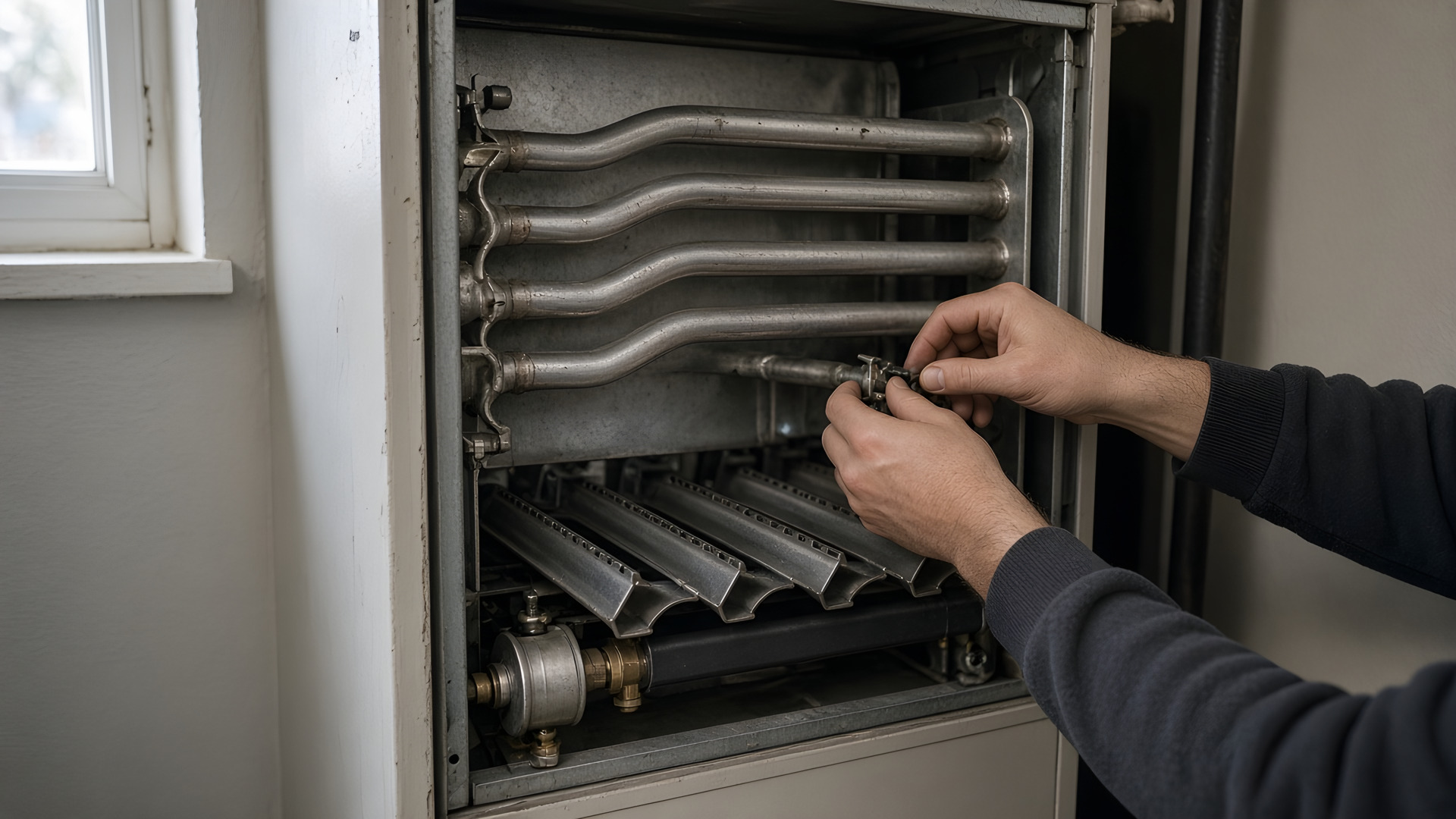
Signs we hear about on the phone
- Air from the vents feels cool or barely warm.
- The furnace starts, runs a minute, shuts off and tries again.
- Clicking at the furnace, but the burners never light.
- The blower runs nonstop, even after the house is warm.
- A new rumble, squeal or bang when it starts.
- The status light on the board blinks a pattern it did not blink before.
How a furnace repair visit goes
- 01We ask what it is doing
On the phone we ask what you hear and see, whether it burns natural gas or propane, and roughly how old it is. That tells us which parts to load on the truck.
- 02We read the furnace first
Before touching anything we read the fault code, check the filter and watch one full start. A lot of furnaces show what is wrong if you watch them try.
- 03We test the safety chain
Igniter, flame sensor, pressure switch, limit switch, inducer motor and gas valve get tested in order. Each one has to pass before the next one gets a turn.
- 04We explain the fix and the price
You hear what failed, why we think it failed and what the repair costs before we start. If the part is not on the truck, we tell you how long it takes to get it to Vernal.
- 05We run a full heat cycle
After the repair we run the furnace from a cold start through a full cycle, check the temperature rise and test for carbon monoxide at the flue and in the room.
Parts we check on most furnace calls
| Part | What we look for |
|---|---|
| Flame sensor | Buildup that makes the furnace shut off a few seconds after it lights. |
| Hot surface igniter | Hairline cracks or a weak glow, common on units that cycle a lot in cold weather. |
| Pressure switch and hose | Water in the hose or a split line, often from a blocked or frozen vent pipe. |
| Inducer motor | Bearing noise and a slow start. |
| Heat exchanger | Cracks, rust holes or scorch marks from flame rollout. |
| Filter and return air | A packed filter or a closed return that trips the high limit. |
What changes the cost of a furnace repair
- The part that failed
- Cleaning a flame sensor is a short job. A control board or inducer motor costs more, and part prices differ by brand.
- Natural gas or propane
- Propane furnaces use different orifices and settings, and some parts are specific to the conversion.
- Age of the furnace
- Parts for older units take longer to find, and sometimes only a universal part fits.
- Where it sits
- A furnace in a tight crawl space or attic takes longer to work on than one in an open utility room.
- Venting
- A frozen, blocked or badly pitched vent pipe has to be fixed too, or the same fault comes back.
Questions about this work
- Why does my furnace keep shutting off after a few minutes?
- A dirty flame sensor is the usual cause. The furnace lights, does not sense the flame and shuts the gas off for safety. A packed filter tripping the high limit is the next most likely reason.
- Can I keep running a furnace that makes a burning smell?
- A dusty smell for a few minutes on the first cold day is normal. A smell that lasts, or one like hot plastic or wiring, means turn it off at the thermostat and call us.
- Do you work on propane furnaces on ranch properties?
- Yes. Many homes outside Vernal, Jensen and Ballard run on propane. We repair and set up those furnaces with propane parts and propane gas pressure.
To set up a visit, call (435) 432-0436.